|
Culture of Goa
Goa State has a history of communal harmony
and unity in diversity.
The most popular celebrations in the Indian state of Goa are Ganesh
Chaturthi (Chavoth-Konkani), Diwali, Christmas (Natalam -Konkani), Easter (Paskanchem
Fest -Konkani), Samvatsar Padvo or Sanvsar Padvo, Shigmo (spring
festival),Carnival, Christmas(Carnaval' or Intruz -Konkani). Goa is also
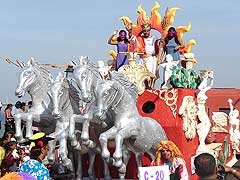
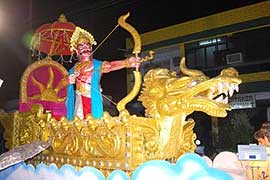
known for its New Year's celebrations. The Goan Carnival is known to attract
a large number of tourists.
Rice with fish curry (Xit kodi in Konkani) is the staple diet in Goa.
Goan cuisine is renowned for its rich variety of fish dishes cooked with
elaborate recipes. Coconut and coconut oil is widely used in Goan
cooking along with chili peppers, spices and vinegar giving the food a
unique flavour. Pork dishes such as Vindaloo, Xacuti and Sorpotel are cooked
for major occasions among the Catholics. An exotic Goan vegetable stew,
known as Khatkhate, is a very popular dish during the celebrations of
festivals, Hindu and Christian alike. Khatkhate contains at least five
vegetables, fresh coconut, and special Goan spices that add to the aroma. A
rich egg-based multi-layered sweet dish known as bebinca is a favourite at
Christmas. The most popular alcoholic beverage in Goa is feni; Cashew feni
is made from the fermentation of the fruit of the cashew tree, while coconut
feni is made from the sap of toddy palms.
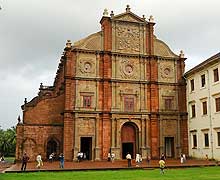
Goa has two World Heritage Sites: the Bom Jesus Basilica and a few
designated convents. The Basilica holds the mortal remains of St. Francis
Xavier, regarded by many Catholics as the patron saint of Goa (the patron of
the Archdiocese of Goa is actually the Blessed Joseph Vaz). Once every ten
years, the body is taken down for veneration and for public viewing. The
last such event was conducted in 2004. The Velhas Conquistas regions are
also known for its Goa-Portuguese style architecture.
In many parts of Goa, mansions constructed in the Indo-Portuguese style
architecture still stand, though in some villages, most of them are in a
dilapidated condition. Fontainhas in Panaji has been declared a cultural
quarter, showcasing the life, architecture and culture of Goa. Some
influences from the Portuguese era are visible in some of Goa's temples,
notably the Mangueshi Temple, although after 1961, many of these were
demolished and reconstructed in the indigenous Indian style.
Mando and dulpod are traditional goan musical forms.
Goan Hindus are very fond of Natak, Bhajan and Kirtan. Many famous Indian
Classical singers hail from Goa, such as, Kishori Amonkar, Kesarbai Kerkar,
Jitendra Abhisheki, Prabhakar Karekar.
Many Goans also perform Western classical music
Some traditional Goan dance forms are dekhnni, fugdi, and corridinho.
Western social dancing is a part of most celebrations.
Tiatr is the major Goan form of theatre.
(Courtesy : Wikipedia.org) |